

An Imperfect World
I met Elizabeth at a party on a September evening in 2024 when I had uncharacteristically remembered to stick a few business cards in my wallet before leaving the house. “Ooooh you’re BIVIO!” she smiled when our mutual friend, the host, introduced us. “We should absolutely have a chat.” I looked down at her card and thought, bingo.
Elizabeth was probably ten years my junior, had moved to Milan from London less than two years prior and, according to her card, was currently a Sustainability Officer for the Luxury Fashion House whose logo I had already spotted on the buttons of her blazer and her blingy earrings.
“Sustainability Officer? Nice!” I smiled, trying to sound more impressed than skeptical. “That sounds like a fun challenge”.
She laughed. “Yes, let’s say I have my work cut out for me. But seriously though…would BIVIO be interested in looking at our ‘seconds’ stock? We have warehouses full of slight defects and one of my ideas was to reach out to second hand resellers and see if we couldn’t organize a steady exit stream. Is that something BIVIO might be interested in doing?”
“One-hundred percent,” I said. “BIVIO would love to talk exit streams for LFB” (which is what I will call this Luxury Fashion Brand).
While sipping our drinks, I explained to Elizabeth that for the startup period of BIVIO, we regularly bought “lightly defected” goods from an international online reseller specializing in multi-brand past collections until their policy changed and they set a €20k minimum order for B2B customers. That wasn’t “sustainable” for us in 2013, when we only had one shop and were very cautious with our cash.
“I think the main problem we might have with LFB would be price points.” I knew that the blazer she was wearing retailed for upwards of 2k. And that BIVIO would sell it for less than ¼ of that price if it ever came through our doors in nearly perfect condition – less if it were missing buttons or a care label or had discoloring on the collar.
Elizabeth reassured me that she’s shopped at BIVIO and knows our pricing well and finds it “refreshingly logical”. “Look,” she says, sipping her prosecco and lowering her voice, “We are talking about literally thousands of items just sitting in a warehouse for years. “My main goal here is to get the usable items out of those boxes and into the marketplace. Right now it’s just a passive cost for the brand. I’m sure we can find solutions that work for both of us.” I urged her to send an email as soon as possible and that I could make a visit to see their inventory literally any time she wanted.
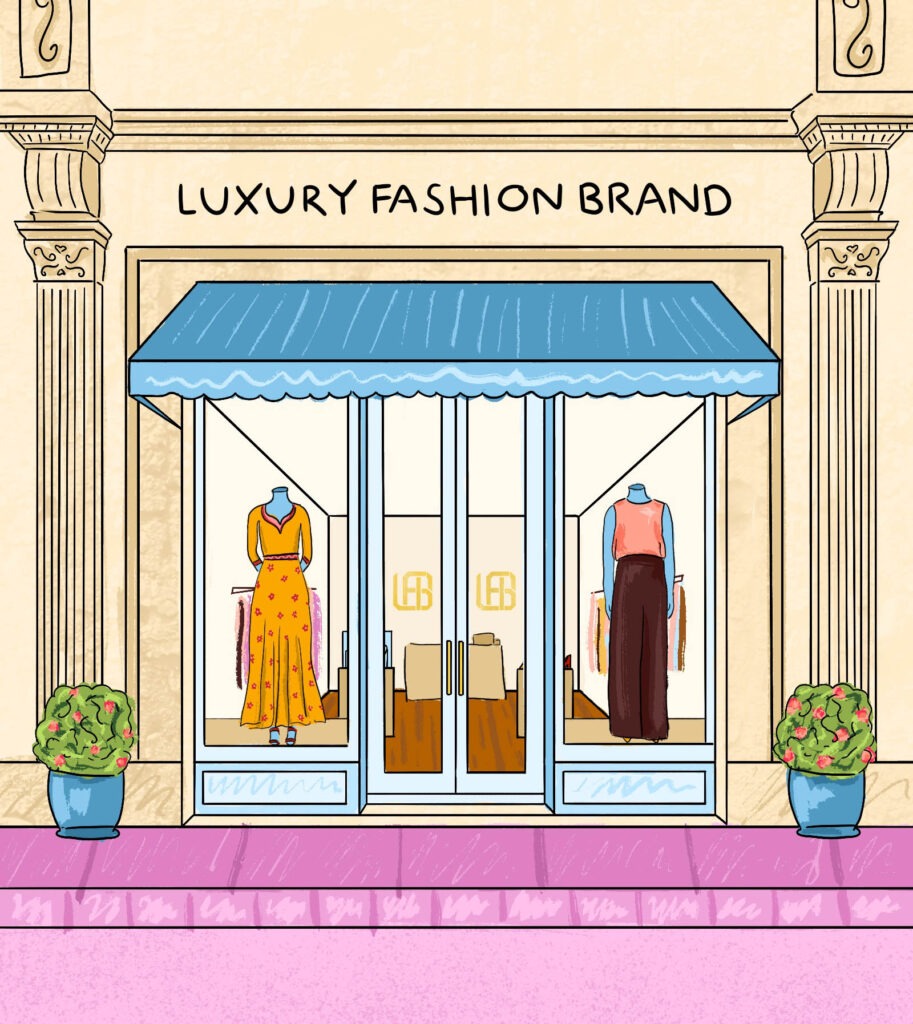
Almost five months later, on a cold, damp, grey January morning, after having exchanged no fewer than 15 emails with Elizabeth and other LFB employees across various departments, and after two appointments getting cancelled at the last minute, Marco and I finally managed to visit the LFB warehouse to see their sub-standard inventory. The warehouse was about 40 minutes away from the center of Milan, in the direction of the Malpensa airport. If you have ever been to a Flagship office of a Luxury Fashion Brand, or if you can imagine what one might look like in a Baroque Palazzo in the Historical Center of Milan, this was the exact opposite.
We arrived at 9.30 am. “Dress warmly,” Elizabeth had suggested in an email. “The warehouses aren’t heated.” Marco and I were greeted by Elizabeth and her colleagues from the Defective Department (a name I invented but it renders the idea) who were already standing in the reception area when we arrived. We were given name tags and guest passes, had to leave our IDs at the front desk and weren’t allowed to pull out our phones at any time. We politely declined the offer of vending machine espresso but Marco accepted a bottle of San Pellegrino. I virtue signaled by pulling a Yeti out of my bag and taking a generous sip. “This place is like a cross between the Pentagon and a morgue,” I whispered to Marco. “Can you imagine having to come here to work every day?” he whispered back. “Not exactly glamorous. But they do have San Pellegrino.”
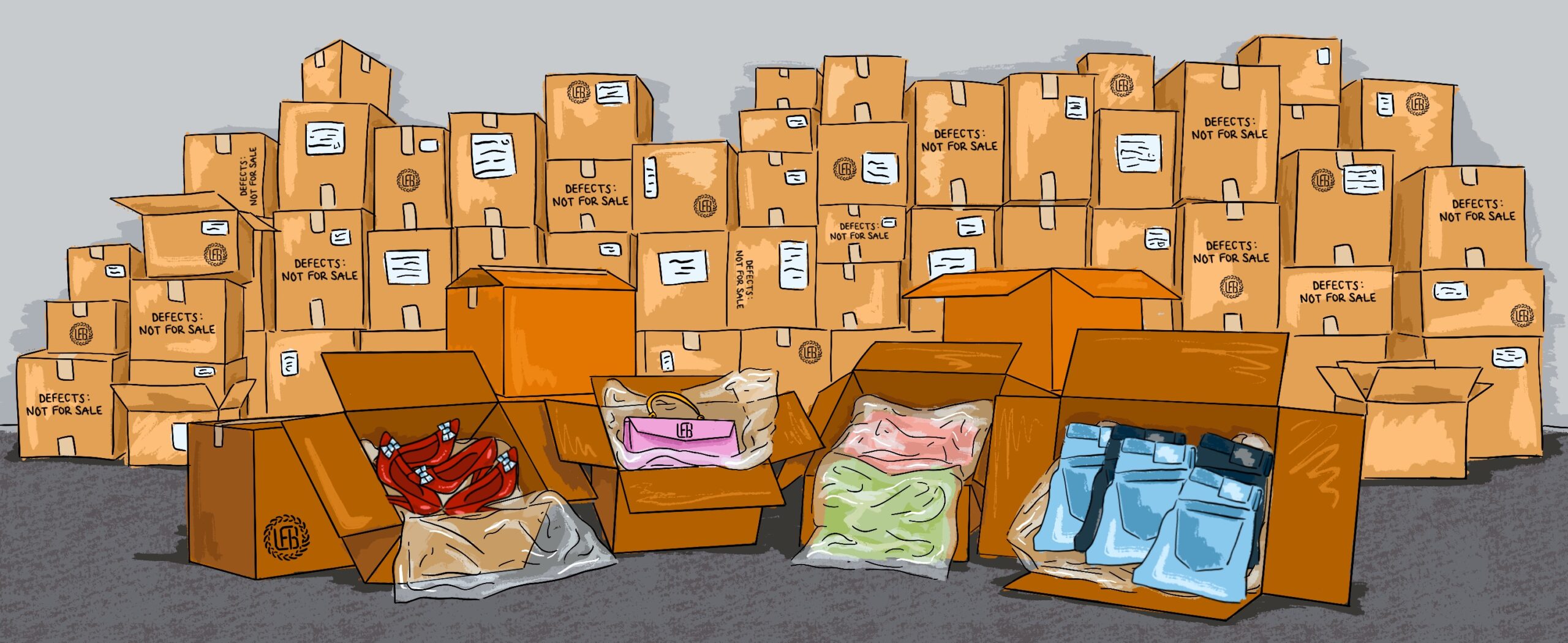
We walked several through cavernous rooms stacked to the ceiling with cardboard boxes on wooden pallets, where men wearing steel-toe boots and non-branded workwear moved things around and packed and unpacked items wrapped in plastic and beeped bar codes from stickers. The LFB logo, instantly recognizable to most Europeans over the age of twelve, was stamped on the boxes and on the plastic wrapping inside the boxes. We were led into an office where there were a dozen open boxes, all filled to the brim with items meticulously sealed in more plastic. Marco shot me a look; he knows how I feel about plastic.
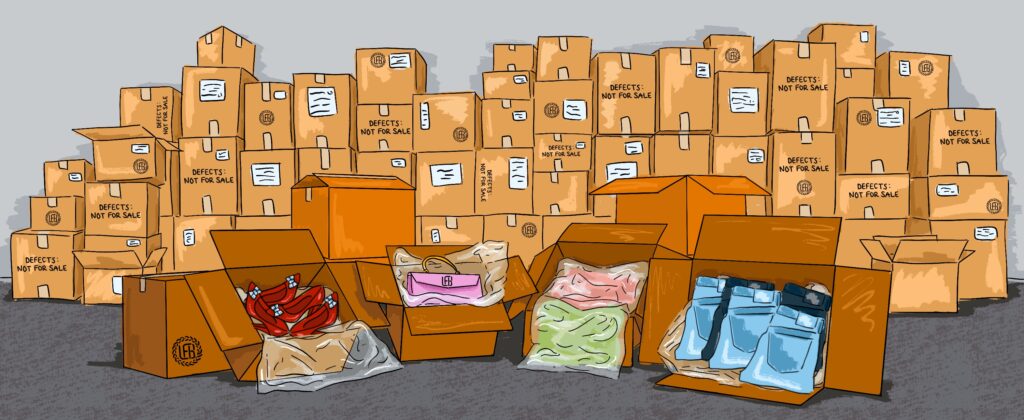
“Ok, so we put aside a selection from our seconds category, so you can get an idea of the kinds of defects we’re talking about here,” Elizabeth said. “You said it would be best to start with accessories and leather goods, right? I also brought out some ready-to-wear but from the more basic categories so we could also get an idea of what might sell well with your customers.”
For those who don’t know, defects are a huge issue for the entire fashion industry – most specifically for the luxury sector, whose very existence relies on the impression of perfection and scarcity. Brands that curate runway shows with strict VIP lists must meticulously monitor every aspect of the manufacturing process in order to avoid holes, snagged threads, crooked stitching or scratches on metallic hardware or leather. Despite their best efforts and cutting-edge assembly lines, mistakes are made. And these mistakes must be hidden from a demanding client base, yet also not be made easily available to consumers who may not be ideally positioned to represent the label.
And this where, a Sustainability Officer would hope, a second-hand retailer like BIVIO could enter the picture. The committed thrifter operates according to a very different consumer mindset than someone willing to pay twelve hundred euros for a pair of jeans. Theoretically, a customer who shops at BIVIO is more than happy to overlook a few minor flaws in order to snatch up a good-quality item at a fraction of the retail price. The whole purpose of our business is to convince consumers that scuffing on the soles of shoes, a pulled thread, a missing button or even a pen mark on a leather bag doesn’t mean the end of its use – which is easier to achieve if an item carries the name of a sought-after brand. Since BIVIO has a steady supply of sellers who are ready to part with past season’s pieces even from high-end labels, buying a couple hundred slightly defective pieces from LFB and spreading them out across four stores wouldn’t cause any suspicion among shoppers that the items had come directly from the Maison itself. Which is exactly what both BIVIO and LFB wanted to avoid in order to preserve our (opposite) brand identities.
Marco and I spent the next two hours doing quality checks and putting things aside in the yes or “no” pile, just like we do behind the buying counter in the shops. Jeans with a rivet missing, yes. Bags missing a logo charm on the zipper, yes. Sunglasses with cracked lenses, no. Bikini tops missing a bottom, no. Logo T-shirts with a tiny hole under the arm, yes. Logo T-shirts whose heat-applied print was already flaking off, no. Silk shirts with a few barely visible pulled threads, yes. Belts with busted buckles, no. Bathrobes without belts, yes. Single earrings, yes.

We paused when we got to a box of giant metal Stanley Cups, each individually wrapped in plastic and entirely bedazzled with Swarovski crystals with the LFH logo in contrasting crystals. There were several colorways. All of them had missing crystals. They were so heavy, even devoid of liquid, that I didn’t understand how someone could walk around with one in their hand. I pulled one out and showed it to Elizabeth. “Oh wow, okay,” I said. “LFB is doing Stanley Cups now? How much does one of these retail for?” “Mmmm, I think like €700 or something,” she answered. Was that irony in her voice? I tried to keep a straight face. Marco and I each picked one up. “I feel like this belongs by a rooftop pool in Dubai,” I thought out loud. “No offense to the Style Office but, uh, I feel like this isn’t really for Milan.” A couple of people from the LFB Defective Department chuckled. Marco said he thought we could find buyers but we’d probably lose too many crystals on the shop floors and also there was no way to attach an anti-theft tag. We politely declined the bedazzled Stanley Cups.
At the end of two hours, we had selected just under two hundred items for the LFB Defective Department to review before sending us a final price list. Marco and I had been extremely clear, both in the exchange of pre-visit emails, as well as during our selection process, at how much we would be willing to pay per each category. BIVIO has been doing this for so many years that we prefer to be super transparent about expectations before showing up to view items – especially when said visit requires a 40 minute drive to an unheated warehouse in the winter. It may sound counterintuitive, but more often than not sellers who work in the Fashion Industry accept our pricing more readily than “end customers” do – because they’re the ones who know how much each item really costs to produce and how high the markups are.
On our drive back to Milan, we tried to guess the actual quantity of deadstock actually contained in all those warehouses. We had probably seen an infinitesimal amount in those 12 boxes. “It’s just insane if you think of the resources that are wasted,” Marco lamented, as our BIVIOmobile inched along the autostrada in midday traffic. “Not even just the merchandise, but the boxes, the labels, the software, the personnel… think of all the salaries going to just manage unsold inventory!” “The plastic… all that packaging…I feel sick,” I said. “We have to tell them we don’t want all that packaging. I hope they don’t wrap all the stuff back in plastic. What will we do with it?”
In the end, it was a problem we never had to address. After ten days, LFB hadn’t yet sent us the price list. When I wrote a follow up email after two weeks, it took them another two weeks to reply. In the month that transpired it had become a widely known-industry secret that LFB was negotiating its sale to a Luxury Holding Company. Not for the first time, either.
When the Approved Price List finally did arrive, they were much higher than what had been discussed. While retail prices for categories like designer bags are often 10 to 15 times their production costs (and markups are higher for items like belts and wallets), the prices they were requesting would have barely allowed us to sell them at our ideal 3x. And since paying upfront for hundreds of flawed items from a single brand from a single supplier was already a risky move for a business like ours, we decided to politely decline the role of exit stream.
It’s been more than a year since we visited the Pentagon/Morgue of LBF. This past February, the EU passed a law banning the destruction (by either shredding, burning or dumping in landfill) of unsold clothing and shoes. While aimed at addressing the problem of over-production by large-scale “fast” fashion companies, the entire textile industry – including high-end brands like LDF – is going to be looking carefully at how they manage their excess inventory, whether it’s unsold remainders from past seasons or “defective” merchandise.
I imagine there will be more Sustainability Officers being hired in the near future, and if I were a young(er) person with an interest in Fashion, I would most likely focus my talents less on trying to make new stuff and more on helping brands figure out what to do with the stuff they’ve already made. Hell, if I were looking for a career change and didn’t have such a phobia of plastic and packaging, I’d probably be a great candidate for Chief Sustainability Officer myself. But as things stand, I’m grateful that the problem of re-homing thirty imperfectly bedazzled Stanley Cups doesn’t fall on my shoulders.
The entrepreneurial part of my brain, however, did light up when I read the news about these new EU measures: maybe compliance will encourage LFB’s Defective Department to reconsider their pricing? I should shoot Elizabeth another email and see if I can’t negotiate an order of single earrings for our customers. Mismatched earrings are a thing now anyway.
At least for a certain kind of imperfect aesthetic.

Leave a Reply